Living with a phobia can feel like being trapped by a false alarm you just can't switch off, making your world feel smaller and smaller. For so many, the big question is, "Can hypnotherapy for phobias actually work?" The answer is a resounding yes—because a phobia is a learned, irrational fear response, and this powerful therapeutic approach gets right to the source to recalibrate it.
Confronting Fear with a New Approach
When you have a phobia, it's as if your mind's security system has a "glitch"—a faulty piece of code that triggers an overwhelming fight-or-flight response to something that isn't a genuine threat. This reaction is entirely automatic and emotional, which is why logic doesn't seem to help. No amount of reassurance that flying is safe will calm the panic of aviophobia if your subconscious mind is convinced otherwise.
This is where hypnotherapy for phobias offers a message of real hope. It's not about just coping with symptoms; it’s about getting to the very root of the problem. It provides a structured, gentle, and completely safe way to communicate with the part of your mind where the phobia is actually stored.
Rewiring Your Inner Alarm System
Think of hypnotherapy as a software update for your brain. In a session, a trained therapist guides you into a state of deep relaxation and focused attention. In this wonderfully calm state, your critical, analytical mind takes a backseat, opening a direct line to your subconscious.
This creates the perfect environment to:
- Identify the Source: Gently explore and uncover the initial event or belief that created the phobic response, even if you have no conscious memory of it.
- Detach the Emotion: Safely unhook the intense feeling of fear from the trigger—whether it's a spider, a height, or an enclosed space.
- Install New Responses: Replace the old, panicked reaction with new, calm, and resourceful feelings.
Here’s a quick overview of how hypnotherapy gets to the heart of the issue:
How Hypnotherapy Targets Phobias at Their Core
This table provides a quick look at the fundamental ways hypnotherapy works to dismantle phobic responses, helping you understand the process at a glance.
| Therapeutic Aspect | How It Helps You |
|---|---|
| Deep Relaxation | Calms your nervous system, making it impossible to feel anxious and relaxed simultaneously. |
| Subconscious Access | Allows the therapist to bypass your critical mind and communicate directly with the part holding the phobia. |
| Emotional Detachment | Helps you view the trigger from a safe, dissociated perspective, stripping away the fear. |
| Positive Suggestion | Installs new, helpful responses and beliefs, creating a default feeling of calm and control. |
| Future Pacing | Lets you mentally rehearse facing your old fear with your new calm response, building real-world confidence. |
Essentially, this process empowers you to update that outdated programming. It helps you understand that a phobia isn't a fixed part of who you are, but simply a learned behaviour—and anything that was learned can be unlearned.
A phobia is essentially a fixed, outdated belief held by the subconscious mind. Hypnotherapy provides the key to accessing that belief and showing the mind that it no longer needs to run that old, fearful programme.
A Journey Tailored to You
Whether you're looking for help in Portsmouth or seeking support online from anywhere in the UK, this guide will walk you through what your journey to becoming phobia-free could look like. We’ll explore how phobias are formed, what a typical session involves, and how this therapeutic approach is always tailored to your specific fear.
Our goal is to build your understanding and confidence, showing you that a life free from the limits of a phobia is not just a dream—it's entirely achievable.
How Phobias Take Root in the Mind
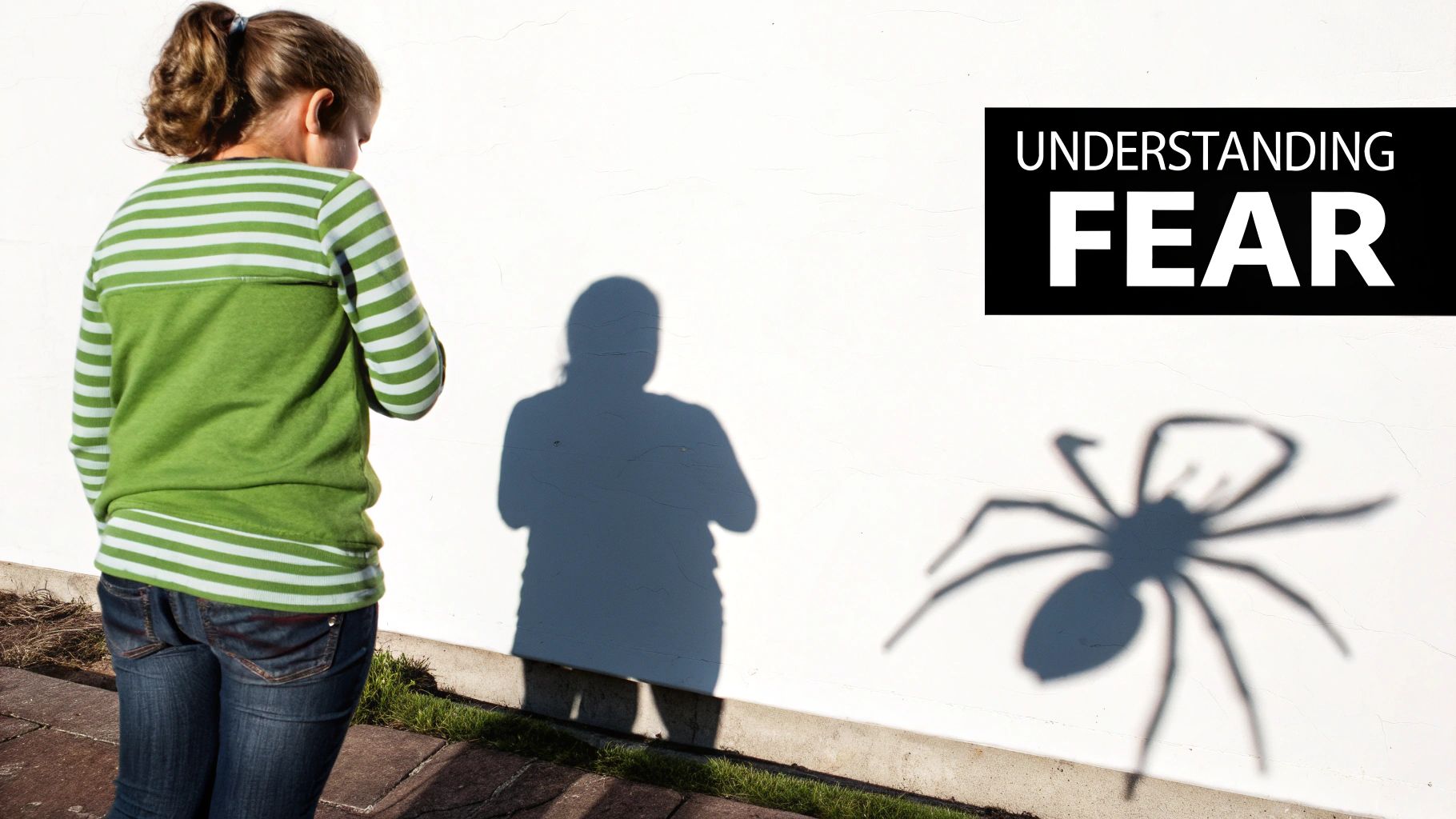
Before we explore how hypnotherapy for phobias can set you free, it’s helpful to understand how a phobia gets there in the first place. The human mind is astonishingly powerful, but sometimes its protective instincts misfire. A phobia isn't a personality flaw or a sign of weakness; it's simply a learned response that has become stuck on a loop.
Think of your subconscious mind as a loyal, highly efficient security guard whose only job is to keep you safe. It bases its decisions on your life experiences and works tirelessly in the background, making split-second choices without you ever having to think about them.
But what happens when this security system gets faulty information? A single, powerful—and often forgotten—event can install a "bug" in its programming. This moment, known as an Initial Sensitising Event (ISE), is when your subconscious mind wrongly connects an object or situation with extreme danger.
The Brain's Faulty Alarm System
This "bug" has nothing to do with logic; it's purely emotional. The ISE could be something you don't even consciously remember. Maybe as a small child, you saw a spider drop onto a parent who screamed in terror. Or perhaps you experienced severe turbulence on a flight years ago. Your conscious mind moved on, but your subconscious security guard took a mental snapshot.
In that critical moment, it created a simple, powerful rule: Spider = Threat. Or Flying = Danger.
From that day forward, the system is primed to protect you from that perceived threat at all costs. This is precisely why logical arguments—"but flying is the safest way to travel!"—have absolutely no effect. You aren't arguing with your rational brain; you're trying to reason with a deeply embedded, automatic safety protocol that believes your life is on the line.
This faulty programming is what triggers the 'fight or flight' response, our most primal survival instinct. When you encounter your phobic trigger, your subconscious security system sounds the alarm, flooding your body with adrenaline and cortisol to prepare you to either fight for your life or run away. This is what causes the very real, very physical symptoms of a phobia:
- A racing heart and shortness of breath.
- Sweating, trembling, or shaking.
- A feeling of overwhelming dread or panic.
- An intense and immediate need to escape.
Your body is reacting as if the danger is real and present, even when your conscious mind knows it isn't.
A phobia is not a flaw in your character; it's a flaw in your subconscious programming. It's a learned response that has become automatic. And the most empowering thing to realise is that anything learned can be unlearned.
The Cycle of Reinforcement
After that initial event, the phobia often gets stronger over time through a simple process of reinforcement. Every time you successfully avoid your trigger—by taking the car instead of the plane, or by bolting from a room where you saw a spider—your brain registers a small, sweet wave of relief.
That feeling of relief acts as a reward. It confirms to your subconscious that its alarm was justified. "See?" your security system tells itself. "I kept you safe by making you avoid that. My programming is correct." This cycle of avoidance and relief makes the phobic response stronger and more deeply ingrained with every repetition.
Understanding this process is the first, crucial step toward taking the phobia apart. It demystifies the fear, changing it from a powerful, unknown monster into a simple, understandable—and entirely fixable—glitch in your mental software. This is the foundation for understanding why hypnotherapy for phobias is so effective; it gives you the tools to directly access and update that security system for good.
Your Hypnotherapy Journey: What a Session Is Really Like
Stepping into therapy for the first time can feel a little daunting. When it comes to hypnotherapy for phobias, many people arrive with questions shaped by stage shows and films, wondering if they’ll lose control or be made to do something silly.
Let’s set the record straight: a clinical hypnotherapy session is a calm, collaborative, and empowering experience where you are always in charge.
Forget the myths about mind control. A therapeutic trance is a natural state of focused attention, much like being so absorbed in a fascinating book that the outside world fades away. Your mind is alert and focused, yet wonderfully relaxed. It’s in this state that your subconscious mind becomes more receptive to positive, lasting change.
The entire process is a partnership. Your hypnotherapist acts as your guide, helping you navigate your own mind to find the solutions that are already within you. The journey is predictable, safe, and designed to help you regain control.
The Initial Consultation: Building Rapport and Setting Goals
Your journey will almost always begin with an initial consultation. This first meeting is crucial; it's less about therapy and more about connection and understanding. Your therapist will want to hear your story in your own words. What is your phobia? How does it impact your life? What do you hope to achieve?
This is your opportunity to ask questions and get a real sense of the person you'll be working with. A good therapist will create a warm, non-judgemental space where you feel completely at ease. Together, you’ll establish clear, positive goals. This isn't just about "not being scared of spiders anymore," but about what that freedom will give you back—like being able to enjoy gardening or relax in your own home.
The Core Steps of a Hypnotherapy Session
Once you're comfortable, the therapy itself begins. While every session is tailored to you, the structure generally follows a clear, logical progression. It's a gentle process designed to make you feel secure at every stage.
The following infographic shows the three core steps that typically form a hypnotherapy session for phobias.
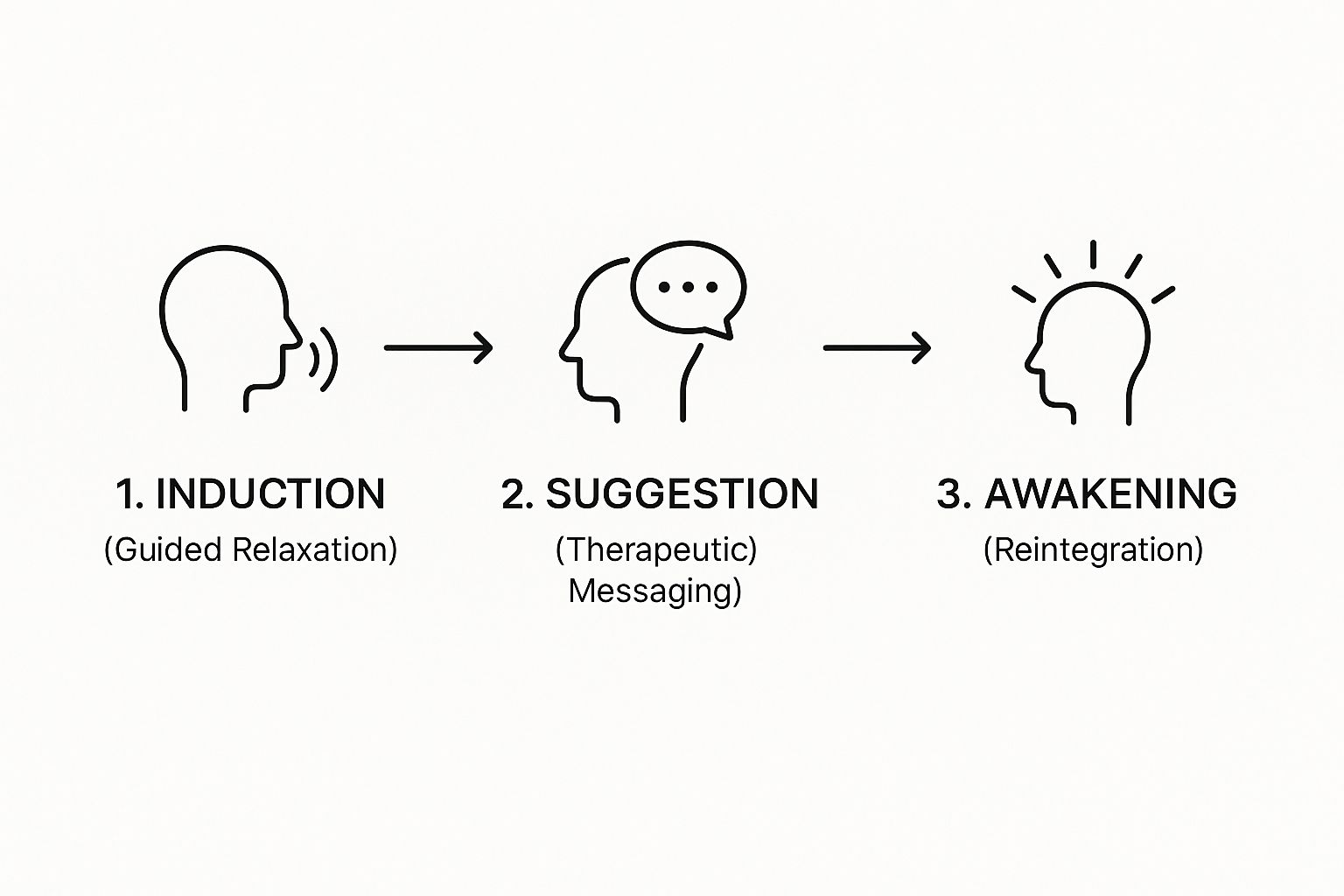
This simple flow from relaxation to therapeutic work and back to full awareness ensures the experience is smooth, predictable, and effective.
Powerful Techniques to Detach the Fear
Inside the main therapeutic part of the session, your hypnotherapist will use specific, proven techniques to help you dismantle the phobia. One of the most powerful and widely used methods is the Rewind Technique.
Imagine your phobia is an old horror film that your mind plays on a loop whenever you see the trigger. The Rewind Technique allows you to safely "rewind" that film and strip away its emotional soundtrack. Your therapist will guide you to a calm, dissociated state—like watching the film from the safety of a projection booth. From this detached perspective, you can watch the events of the memory that created the phobia play out forwards and backwards, very quickly, without any of the original fear.
This process effectively neutralises the toxic emotion attached to the memory. The memory itself remains, but its power to trigger panic is gone. It becomes just another old, neutral file in your mind's library.
The effectiveness of such psychological approaches is backed by real-world data from within the UK. A significant study by Anxiety UK found that therapies including hypnotherapy were highly successful. Their findings showed that 62% of participants achieved recovery from anxiety-related conditions like phobias, with 71% showing reliable improvement—surpassing NHS targets.
Awakening and Integration
After the therapeutic work is done, your therapist will gently guide you back to full waking consciousness. You won't be "snapped" out of it; it's a gradual and pleasant process. Most people report feeling incredibly relaxed, refreshed, and lighter, as if a great weight has been lifted.
The session often concludes with a brief chat about your experience. The positive changes made during hypnosis will continue to integrate in the hours and days that follow. You'll likely notice a natural shift in your response to old triggers, feeling calmer and more in control without even having to think about it. For more examples and explanations, you can explore other articles on the 1life hypnotherapy blog.
Ultimately, a hypnotherapy session is a journey you take with a trusted guide. It’s a process designed to empower you, giving you the tools to rewrite old, fearful responses and step confidently into a life free from the limits of your phobia.
Real Stories of Overcoming Common Phobias

Understanding the theory behind hypnotherapy for phobias is one thing, but seeing it in action is where the possibility of change truly comes alive. The techniques we’ve covered aren’t just abstract ideas; they’re practical tools used to help real people untangle themselves from very real fears.
Let's walk through a few common phobias to paint a clearer picture of how a hypnotherapist tailors the process to your specific situation. While these stories are illustrative, they reflect the journeys of countless people who have successfully reclaimed their lives from fear. They show you what your own success story could look like.
From Aviophobia to Calm Skies
Picture a client we'll call Mark. He’s a sales manager whose job requires regular travel. But for years, he’s been grounded by aviophobia, a crippling fear of flying. Even thinking about an airport triggers a wave of anxiety. He has turned down promotions and missed family holidays because the sheer panic—the racing heart, sweaty palms, and suffocating feeling of being trapped—is just too overwhelming.
In his sessions, a hypnotherapist’s first step would be guiding Mark into deep relaxation. The focus isn't immediately on the plane. It’s on building a powerful internal "safe space" in his mind, a place of total calm and control he can mentally access anytime.
From there, the therapist might introduce the Rewind Technique. While Mark is in this safe, detached state, he can "watch" a past turbulent flight on a mental screen, but with the emotional volume turned right down. He rewinds the memory and fast-forwards it until it feels as neutral as any other thought, stripping it of its power to cause panic.
Finally, the work shifts to positive suggestion and what we call future pacing. Mark would be guided to vividly imagine an upcoming flight, but this time, he's experiencing it completely differently.
- He strolls through the airport feeling calm and in control.
- He settles into his seat, breathing deeply, feeling relaxed.
- As the plane takes off, he notices a feeling of gentle excitement, not dread.
- He even imagines himself looking out the window, genuinely enjoying the incredible view.
By mentally rehearsing this new, calm response, Mark is building new neural pathways. He’s overwriting the brain's old fear program with a new one rooted in confidence and control.
Unravelling Arachnophobia One Thread at a Time
Now, let's think about Sarah, who lives with a severe fear of spiders, known as arachnophobia. It’s far more than a simple dislike; she scans every corner of a room before she can relax and has had full-blown panic attacks from seeing a tiny spider in the bath. Her phobia dictates her life, making her feel constantly on edge, even in her own home.
A therapist working with Sarah would know the spider isn't the real issue; the problem is the catastrophic meaning her subconscious mind has attached to it. Here, an approach like Parts Therapy could be incredibly effective. This technique involves communicating directly with the part of her subconscious that created the fear in the first place.
The therapist would help Sarah understand that this "fearful part" actually has a positive intention—to keep her safe—but it's using an outdated and unhelpful strategy. The goal is to negotiate with this part, thanking it for trying to protect her and helping it find new, more appropriate ways to ensure her safety without triggering panic.
Next, the therapist might guide Sarah through imaginative graded exposure. She could start by picturing a friendly cartoon spider, then perhaps a photograph of a spider from a distance, gradually working her way towards imagining a real spider in the same room—all while remaining in a state of deep relaxation. This desensitisation process gently re-educates her subconscious, teaching it that the old, terrifying alarm is no longer necessary.
Many phobias are tied to wider issues with anxiety. Understanding this link is often a key part of the healing journey. If this resonates, you might find it helpful to learn more about how hypnotherapy addresses panic attacks and anxiety disorders.
Finding Your Voice Beyond Social Anxiety
Lastly, consider David, who struggles with glossophobia, the fear of public speaking. It’s a very common form of social anxiety that's seriously holding him back at work. He actively dodges meetings where he might have to present and is consumed by dread for weeks if a presentation is unavoidable.
For David, the root of the fear is judgement and failure. Hypnotherapy would focus on building his inner resources and boosting his self-confidence from the ground up. A therapist would use powerful, positive suggestions to reinforce his sense of competence and self-worth.
A fantastic technique here would be anchoring. The therapist would help David access a memory of a time he felt incredibly confident and successful. At the absolute peak of that feeling, he’d be coached to create an "anchor"—a simple, discreet physical action, like pressing his thumb and forefinger together. Through repetition, this small gesture becomes a powerful trigger he can use to instantly call up that state of confidence just before he needs to speak.
These stories show that hypnotherapy for phobias isn't a one-size-fits-all solution. It's a creative, flexible, and deeply personal process, all about finding what works for you and rewriting your story from one of fear to one of freedom.
When Hypnotherapy Meets Cognitive Behavioural Therapy
While traditional hypnotherapy does a fantastic job of working with the subconscious, a more modern, evidence-based approach is making waves in the UK for its sheer speed and effectiveness. It’s called Cognitive Behavioural Hypnotherapy, or CBH, and it tackles phobias with even more firepower.
This integrated method combines the deep, receptive state of hypnosis with the practical, thought-challenging tools of Cognitive Behavioural Therapy (CBT). Think of it like being able to update your mind’s core software while the system is in its most open and receptive state. It’s a powerful combination. CBH creates a unique therapeutic window where you can easily identify, question, and ultimately replace the irrational thoughts that fuel your phobic response.
The Best of Both Worlds
In a standard CBT session, a therapist helps you consciously pick apart your negative thought patterns. You might learn to question the thought, "This spider is definitely going to harm me." While this is effective, it can sometimes feel like an uphill battle, pitting your conscious logic against the raw, automatic fear being churned out by your subconscious.
This is where CBH makes the whole process smoother and more intuitive. By introducing these same cognitive techniques while you're in a state of deep hypnotic relaxation, the suggestions can bypass the critical, anxious part of your mind. They sink in more deeply, making it far easier to accept new, more realistic ways of thinking.
This combined approach means you’re not just managing the fear; you're fundamentally changing the thinking that creates the fear in the first place. You learn practical skills for managing your thoughts in the conscious world, supercharged by the deep learning state of hypnosis.
Why This Integrated Approach Is So Effective
This powerful synergy is why CBH is often faster and more efficient than using either hypnosis or CBT on its own. You're working on two levels at the same time: calming the subconscious emotional response while actively retraining your conscious thought processes. It’s a complete system overhaul for your mind's reaction to a phobic trigger.
This integrated model isn't just a niche idea; it’s well-supported and increasingly used by professionals across the UK. Research into hypnotherapy for phobias consistently shows that combining hypnosis with cognitive and behavioural therapies has a significant additive effect, greatly enhancing treatment outcomes. Studies have found this combination leads to bigger improvements in symptom reduction and client satisfaction, cementing its place as a leading-edge therapy. You can dive deeper into the research supporting Cognitive Behavioural Hypnotherapy.
Here’s a simple breakdown of how the two therapies work together in a CBH session:
- Hypnosis: This creates a state of deep relaxation and focused attention. It calms your nervous system right down and opens a direct line to your subconscious mind.
- Cognitive Tools: With your mind in this calm state, the therapist introduces practical CBT techniques. This helps you challenge and reframe the distorted thoughts behind the phobia (e.g., "The flight is dangerous" becomes "Flying is statistically very safe, and I am in control of my calm response").
- Behavioural Techniques: You might be guided to mentally rehearse facing your fear with your new calm mindset and cognitive skills. This technique, known as imaginal exposure, builds real-world confidence in a completely safe, controlled internal environment.
Ultimately, CBH equips you with a versatile toolkit. You get the profound subconscious shifts from hypnosis, but you also walk away with practical, lifelong skills to manage your thoughts and feelings. This ensures the fear doesn’t just disappear—it stays gone for good.
Your Questions About Hypnotherapy for Phobias Answered
Deciding to tackle a phobia is a courageous step, and it’s natural to have questions before you begin. When you’re considering hypnotherapy for phobias, you want to feel sure and informed.
We’ve put together answers to the questions we hear most often from our clients here in the UK. Our aim is to clear up any confusion, tackle your concerns head-on, and give you the confidence you need to take that next step.
How Many Sessions Will I Need and How Long Do They Last?
This is usually one of the first things people want to know. While everyone’s journey is unique, the great thing about hypnotherapy is that it’s designed to be a brief, solution-focused therapy. We're not talking about years of sessions; the goal is to create rapid, lasting change.
For many straightforward phobias, like a fear of spiders or injections, you could feel a huge, permanent shift in as few as three to four sessions. More complex phobias, or those tangled up with deeper anxiety, might just need a couple more.
Each session usually runs for about 60 to 90 minutes. This gives us plenty of time to chat, do the therapeutic work, and gently bring you back to full awareness, all without ever feeling rushed. Your therapist will be able to give you a much clearer idea after your initial chat.
What Does Hypnosis Actually Feel Like?
First, forget everything you've seen in stage shows and movies. That's pure entertainment. Clinical hypnosis is a completely natural and gentle state of deep relaxation, very much like daydreaming or when you’re so lost in a good book that the world around you fades away.
You are not asleep. You are not unconscious. You’ll be aware of everything going on, you'll hear every word your therapist says, and you are in complete control at all times. You can move, speak, or open your eyes whenever you want. Honestly, most people just describe it as being wonderfully calm and deeply relaxing—it's a pleasant experience all on its own.
The hypnotic state simply allows your busy, critical mind to take a back seat for a while. This opens up a direct line to your subconscious, the part of your mind where the phobic response is running, making it far more open to new, positive suggestions that stick.
Will I Be Made to Do or Say Anything Against My Will?
Absolutely not. This is probably the biggest myth out there, and it causes a lot of needless worry. Therapeutic hypnotherapy is a team effort, built entirely on trust and respect between you and your therapist.
You can't be made to do, say, or believe anything that goes against your core values or what you feel is right. Think of it this way: your subconscious has a powerful protective instinct. It would simply ignore any suggestion that you didn't agree with. You are always the one in charge; the therapist is just your guide.
How Do I Know If Hypnotherapy Will Work for Me?
While no therapy on earth can come with a 100% guarantee, the success rates for treating phobias with hypnotherapy are incredibly high. Really, the main thing you need for it to work is a genuine desire to change and a willingness to go with the process.
If you are motivated to finally beat your phobia and you're open to the idea of working with your subconscious mind, you're a fantastic candidate. The science backs this up, too. Clinical research consistently shows huge benefits for anxiety and phobias. For example, a major meta-analysis found that after treatment, the average person who had hypnosis experienced better anxiety outcomes than 79% of people who didn't. This figure jumped to over 84% at the longest follow-up, which shows the changes aren't just significant, they last. You can find more on these powerful hypnotherapy findings in the study published by the International Journal of Clinical and Experimental Hypnosis.
Is It Expensive and Is It Available on the NHS?
The cost of private hypnotherapy for phobias in the UK can vary based on the therapist's location, their experience, and how long the sessions are. It’s helpful to see it as a short-term investment in your long-term quality of life. Since many phobias can be resolved in just a handful of sessions, the total cost is often much less than other, longer-term therapies.
At the moment, hypnotherapy isn't widely offered on the NHS for phobias, although some GPs might keep a list of local, accredited therapists. The vast majority of people who choose this treatment do so privately. When you're looking for a therapist, the most important things are their qualifications and the connection you feel with them. For more help on this, our guide on choosing the right hypnotherapist has some really useful tips.
Finding the right person is the most critical part of the process. A skilled, compassionate therapist will make you feel safe, understood, and confident that you can make this change.
At 1 life hypnotherapy, we're here to help you break free from the grip of fear. Whether you're looking for in-person sessions in Portsmouth or prefer online therapy from anywhere in the UK, we're ready to support you. Contact us today to find out how we can help you get your life back.
Article created using Outrank